

Is Your Health Insurance company different? When you have Health Insurance, your health card is sometimes printed with names that are not the actual provider you deal with during any hospitalisation. Instead, there is some third party who will manage the communication pertaining to the claims, cashless approvals, tie-up with the hospitals and the customer care services for the member. This is known as TPA.
Good Health Insurance TPA Limited is working as a Third Party Administrator (TPA) for the Insurance Companies for performing various health insurance services. It states to have a license for the same from IRDAI, with License No. 023. Its official website also lists services related to cashless hospitalization, member cards, claims, and healthcare assistance.
For someone seeing the term “Good Health TPA” on an insurance card or hospital document for the first time, the process can feel confusing. Is Good Health TPA the insurance company? Does it pay the claim? How does cashless hospitalization work? Where can you get an e-card?
This guide explains these questions in simple language.
Table of Contents
What Is Good Health TPA?

Good Health TPA means Good Health Insurance TPA Limited, which is the third-party administrator of a health insurance policy that administers claims and claims-related procedures.
The easiest way to understand a TPA is to imagine it as a bridge.
There are usually three important parties involved in a health insurance claim:
- The policyholder who needs medical treatment
- The hospital providing the treatment
- The insurance company responsible for the policy and claim
A TPA can sit between these parties and coordinate important claim-related activities.
For example, if you are hospitalised at a network hospital, the hospital may contact the TPA to verify your policy details and initiate the cashless authorisation process.
This does not mean the TPA becomes your insurer.
The insurance company remains responsible for the insurance contract and coverage. Good Health TPA’s role is primarily to administer and coordinate healthcare and claim services according to the applicable policy terms.
What Does a TPA Actually Mean?
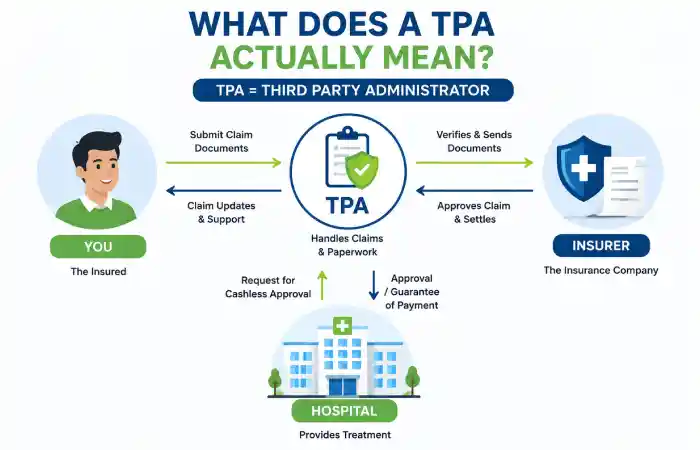
TPA stands for Third Party Administrator.
In health insurance, a TPA is an organisation appointed by an insurance company to provide specified health-service administration.
This distinction is important because people sometimes assume that the TPA itself sells the insurance policy.
It generally does not.
Think about it this way:
The insurer provides the insurance. The TPA helps administer the healthcare and claim process.
The exact services can vary depending on the insurance arrangement, but they may include:
- Claim registration
- Cashless hospitalisation coordination
- Pre-authorisation processing
- Hospital communication
- Document verification
- Reimbursement claim administration
- Member assistance
- E-card services
- Network hospital information
Good Health TPA describes its role as helping policyholders access healthcare services and coordinating areas such as cashless accessibility and hospital-related processes.
Good Health TPA vs Health Insurance Company
This is probably the most important distinction to understand.
| Feature | Good Health TPA | Health Insurance Company |
| Main role | Health insurance administration and coordination | Provides the insurance policy |
| Issues insurance policy | Generally no | Yes |
| Handles claim administration | Yes, where appointed | Yes, ultimately responsible under policy |
| Coordinates cashless requests | Yes | May work through a TPA or internally |
| Determines policy coverage | No; follows policy terms | Yes |
| Provides member/e-card services | Depending on policy arrangement | May provide them directly or through TPA |
| Pays eligible claim | No, as the insurer | Yes, subject to policy terms |
The distinction matters whenever there is a disagreement about a claim.
A TPA may process information and communicate decisions, but the underlying coverage is determined by the insurance policy issued by the insurer. A current independent guide on Good Health Insurance TPAs similarly notes that the TPA does not issue policies or independently decide whether a claim is covered.
Why Do Insurance Companies Use TPAs?
Health insurance involves a surprising amount of coordination.
A single hospitalisation can involve:
- Patient admission
- Insurance verification
- Hospital bills
- Medical reports
- Treatment details
- Pre-authorization
- Discharge documents
- Claim forms
- Reimbursement calculations
- Communication between several parties
Managing all of this requires an organised system.
A TPA can provide a dedicated administrative layer between hospitals, insured members, and insurers.
This can be particularly useful for group health insurance policies offered through employers and other organisations.
The goal is not simply paperwork. A well-managed claims process can make the hospitalisation experience less confusing for the patient and family.
Good Health TPA says its services include helping subscribers with hospital selection, cashless accessibility, and healthcare-related coordination.
What Services Does Good Health TPA Provide?
The exact services available to you depend on your insurance policy and the arrangement between your insurer and Good Health TPA.
However, some common areas include the following.
1. Cashless Hospitalisation
Cashless treatment is one of the most useful features associated with health insurance.
If your policy permits cashless treatment and you use an eligible network hospital, you may not have to pay the entire admissible hospitalisation bill upfront.
Instead, the hospital and TPA coordinate the authorisation process.
It is important to understand one word here: admissible.
Cashless does not necessarily mean every hospital expense becomes free.
Your policy may have:
- Deductibles
- Co-payments
- Room-rent limits
- Sub-limits
- Non-covered expenses
- Waiting periods
- Exclusions
The patient may still have to pay amounts that are outside the policy’s coverage.
2. Pre-Authorization
For planned hospitalisation, the hospital generally starts a cashless request before treatment.
The TPA reviews the information supplied by the hospital and checks it against the available policy information.
This process is commonly called pre-authorisation.
It can involve details such as:
- Patient information
- Policy or member identification
- Diagnosis
- Proposed treatment
- Estimated expenses
- Hospital information
- Medical documents
A pre-authorization request should not be interpreted as a guarantee that every final expense will be covered.
The final claim remains subject to the policy’s terms and conditions.
3. Reimbursement Claims
Not every hospitalisation happens at a network hospital.
In situations where reimbursement is permitted by the policy, the insured may pay the hospital and later submit the required documents for claim processing.
Typical documentation can include:
- Claim form
- Hospital bills
- Discharge summary
- Prescriptions
- Diagnostic reports
- Payment receipts
- Medical reports
- Other documents requested for the claim
The exact requirements depend on the insurer and policy.
This is why keeping every hospital document is a simple habit that can save a lot of trouble later.
What Is the Good Health TPA E-Card?
An e-card is a digital version of the health insurance membership or identification card.
Good Health TPA provides member-card functionality through its digital services. Its official website mentions a portable member card, while its GetSetGo application describes features for accessing member information and downloading Good Health member cards.
The e-card can be useful when visiting a hospital because it may contain information needed to identify the insured member.
Depending on the policy, it may show information such as:
- Member ID
- Employee or policy information
- Insured person’s name
- Dependents
- Other identification details
However, carrying only the e-card is not always enough.
A hospital may ask for additional documents or identification before beginning treatment.
What Is the Good Health TPA Member Portal?
A member portal is designed to give insured members access to information associated with their health insurance arrangement.
Depending on the policy and available service, users may be able to access information related to:
- Member details
- Dependents
- Sum insured
- Claim information
- E-card
- Hospital-related information
Good Health’s mobile application description specifically mentions access to dependents, sum insured, claim details, and downloadable member cards.
If you are trying to log in, use the credentials supplied to you by your employer, insurer, or Good Health TPA rather than relying on login details found on random websites.
How Does Good Health TPA Cashless Treatment Work?
The process can look complicated when you’re experiencing it for the first time, but the basic idea is straightforward.
Step 1: Choose an Eligible Hospital
First, confirm that the hospital is part of the applicable network for your policy.
Do not assume that a hospital accepts every insurance policy simply because it displays several insurance and TPA names.
Hospital tie-ups can vary by insurer, policy, location, and arrangement.
Large hospital groups, including KIMS and Max Healthcare, list Good Health TPA among their associated TPA organizations.
Step 2: Show Your Insurance Information
At the hospital insurance or TPA desk, provide your e-card or member details.
The hospital may also request an identification document.
Step 3: Submit the Pre-Authorization Request
For planned treatment, the hospital generally submits the required pre-authorization information.
Step 4: TPA and Insurer Process the Request
The request is examined according to the information available and the policy terms.
Step 5: Treatment Takes Place
Once the required authorization is completed, treatment can proceed according to the hospital’s process.
Step 6: Final Claim Processing
At discharge, the final bill and treatment details are processed.
The final payable amount can differ from the initial estimate.
What Happens During Emergency Hospitalization?
Emergency treatment is different from planned hospitalization because there may be no time to complete every step beforehand.
The most important thing is to get necessary medical treatment first.
After admission, the patient or family should contact the hospital’s insurance/TPA desk as quickly as possible.
The hospital can guide you about the required claim intimation and authorization process.
Good Health TPA’s official website provides separate guidance for emergency admission and hospitalization procedures.
If you are dealing with an emergency, don’t delay necessary medical care simply because you are uncertain about insurance paperwork.
How to Check Good Health TPA Network Hospitals
A network hospital is a hospital that has an arrangement relevant to your insurance/TPA setup for cashless treatment.
The phrase “network hospital” should not be interpreted as a permanent universal list.
Hospital arrangements can change.
Before planned hospitalization, it is sensible to:
- Check the current network hospital list.
- Contact the hospital’s insurance desk.
- Confirm that your particular insurer and policy are accepted.
- Ask whether cashless treatment is available for your planned procedure.
- Carry your member/e-card and identification.
This small amount of preparation can prevent an unpleasant surprise at admission.
Good Health TPA Claims: What Should You Keep Ready?
One of the easiest ways to make an insurance claim smoother is to organize your documents from the beginning.
Keep copies of:
- Health insurance card/e-card
- Policy details
- Government-issued identification
- Hospital admission papers
- Consultation records
- Medical reports
- Prescriptions
- Original bills and receipts
- Discharge summary
- Pharmacy bills where applicable
- Diagnostic reports
- Payment proof
- Claim forms
Don’t throw away documents immediately after discharge.
A bill that looks insignificant at the hospital may become useful when the claim is being reviewed.
Why Can a Health Insurance Claim Be Delayed?
A delay does not automatically mean that the claim has been rejected.
There can be several reasons for additional processing.
For example:
Incomplete Documents
If important documents are missing, additional information may be requested.
Policy Waiting Period
Certain illnesses or treatments may be subject to waiting periods.
Exclusions
Some expenses may not be covered under the policy.
Medical Clarification
Additional medical information may sometimes be required.
Mismatch in Information
Differences between the policy details and submitted documents can create additional questions.
A useful rule is simple: never assume that a claim is covered merely because the treatment happened in a network hospital.
The hospital network and insurance coverage are two different concepts.
Is Good Health TPA the Same as Good Health Insurance?
The names can understandably cause confusion.
Good Health Insurance TPA Limited is a TPA, not the same thing as being the insurer that issued your health insurance policy.
Your policy document should tell you which insurance company provides your actual coverage and which TPA has been appointed, if any.
If you need to understand whether a treatment is covered, start with your policy wording rather than relying only on the TPA name printed on the card.
Good Health TPA Customer Support
At the time, their official website provides customer care and also senior citizen care-related details, along with WhatsApp support details of the company. Because contact details may update with time, It may a better option to check the most up-to-date contact details through their dedicated company website, instead of reusing from older blogosphere posts and other Social networking websites.
Specially with matters concerning sensitive insurance-related information.
Never share your:
- Password
- OTP
- Banking PIN
- Card PIN
- Unnecessary personal information
with an unknown caller claiming to represent an insurance or TPA organization.
Good Health TPA Mobile App
Good Health TPA has a mobile application called GetSetGo.
The app listing describes it as a Good Health TPA service that provides information such as dependents, sum insured, claims, and downloadable member cards.
A mobile app can be convenient because your insurance information is easier to access when you’re away from home.
Still, an app should be considered a convenience tool rather than a replacement for the actual insurance policy.
The policy wording remains the important document when you need to understand coverage, exclusions, limits, and conditions.
Advantages of Using a TPA
There are some practical advantages to having a TPA involved in health insurance administration.
Easier Hospital Coordination
The hospital’s insurance desk can coordinate claim-related communication with the TPA.
Cashless Assistance
For eligible cases, the TPA can facilitate the cashless authorization process.
Digital Member Services
E-cards and online services can make policy information easier to access.
Claim Tracking
Digital systems may allow members to view relevant claim information.
Dedicated Support
A TPA can provide a specific contact point for healthcare-related administrative questions.
However, the actual experience can differ depending on the insurer, hospital, policy, documentation, and individual claim.
Limitations You Should Understand
It would be misleading to assume that having a TPA automatically means every claim will be quick or every hospital expense will be covered.
A TPA operates within the framework of the insurance policy.
For example, if your policy excludes a particular expense, the TPA cannot simply turn that expense into a covered benefit.
Similarly, if your policy has a room-rent limit or co-payment, those conditions can affect your final out-of-pocket expense.
That is why reading the policy document is still essential.
Tips for a Smoother Good Health TPA Claim
Here are some practical habits I would recommend to anyone using a TPA-managed health insurance policy:
Keep your e-card accessible. Save a digital copy on your phone.
Know your insurer. Don’t confuse the TPA with the company that issued your policy.
Check the network hospital before planned treatment.
Inform the appropriate parties promptly during hospitalization.
Keep every medical document.
Ask questions before signing hospital documents.
Understand your room-rent and co-payment conditions.
Check exclusions and waiting periods before assuming something is covered.
Use official customer-support channels.
Most importantly, don’t wait until you’re standing at a hospital reception desk to learn how your health insurance works.
A few minutes of preparation can make a stressful situation much easier.
Final Thoughts on Good Health TPA
Understanding Good Health TPA becomes much easier once you separate the roles of the insurer, TPA, and hospital.
The insurer provides the health insurance policy. The hospital provides medical treatment. The TPA can help coordinate the administrative side of claims, cashless hospitalization, member services, and communication.