
A round, red, and itchy skin patch makes you automatically think of ringworm. With a name like ringworm, the appearance implies it would clearly stand out from a whole host of other problems; however, appearances can be deceptive in more ways than one. Many skin conditions cause the formation of round, oval, or circular-shaped, scaly, and/or ring-shaped rashes which can be nearly identical to the characteristic fungal infection.
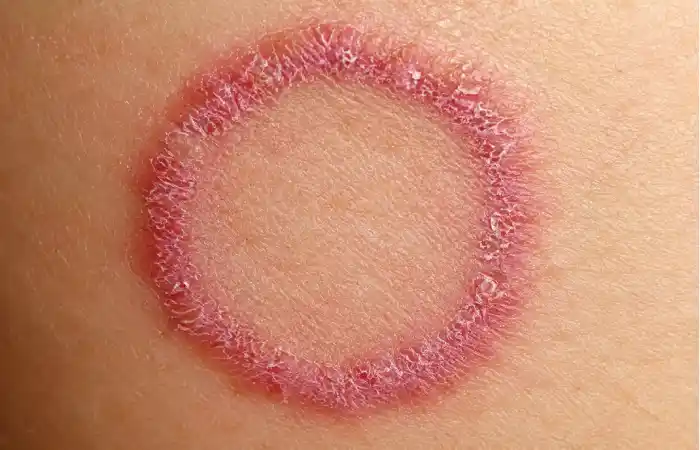
Ringworm, otherwise called tinea corpo ris when it infects the skin on the torso, is one of many different types of fungal infection by dermatophytes, which tends to cause an itchy, scaly rash with a clearly raised outer border and normally clearer skin in the center of the ring-shaped lesion that the lesion often assumes.
There are a variety of different forms of eczema, psoriasis, and even contact dermatitis, the occurrence of which can create identical-looking red, oval and/or round rashes to that of the fungal infection Ringworm.
Table of Contents
What Does Ringworm Usually Look Like?
Ringworm isn’t caused by a worm, either. It’s a fungal skin infection that you can get from another person, an animal, or by touching an object with fungus on it.
On the body, the classic rash is often:
- Round or ring-shaped
- Itchy
- Scaly
- More noticeable around the outer edge
- Raised or slightly inflamed around the border
- Clearer or less irritated toward the center
The rash may start to spread outwards, making a more clear-cut ring.
The rash can occur on many parts of the body – on the arms, on the legs, on the torso, on the face. It is this type of fungus that causes what we would call athlete’s foot or jock itch.
The whole thing is really saying that ringworm looks remarkably like other diseases, some of which are not communicable at all.
Rashes That Look Like Ringworm But Aren’t
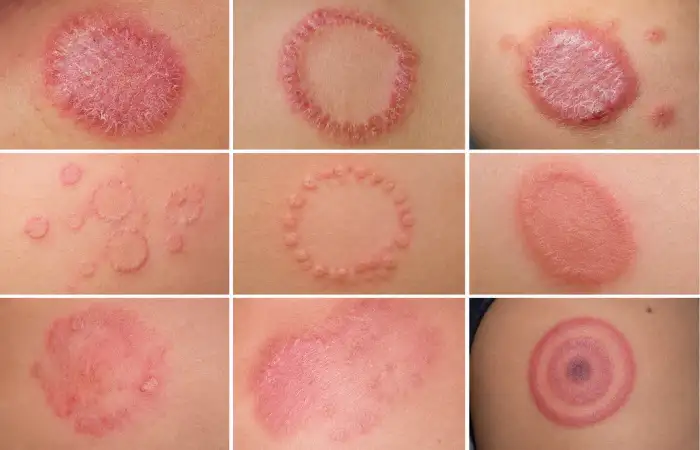
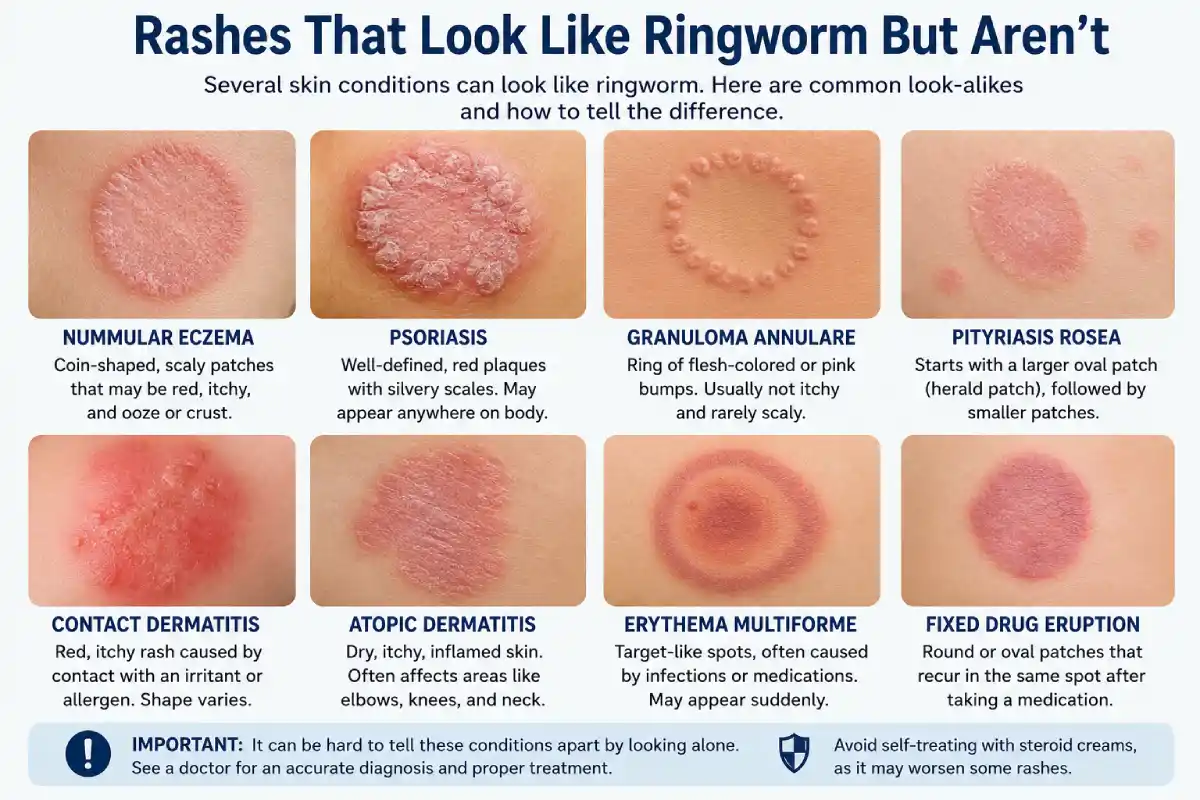
The following conditions are among the more common possibilities when a circular or ring-like rash does not turn out to be ringworm.
1. Nummular Eczema
Nummular eczema: Another of the best ringworm look-alikes comes in at nummular or discoid eczema. This form of eczema causes coin- or disc-shaped patches that are often red, dry, cracked, scaly, or itchy. They tend to be uniformly irritated across the patch, unlike ringworm, which typically has a clear active border with a clear center.
Also characteristic of nummular eczema is intense itching, particularly when the skin is dried out.
Actually an inflammatory condition, not a fungal one, nummular eczema’s appearance alone may prompt the diagnosis of ringworm, with frustration ensued when the antifungal cream proves ineffective.
2. Psoriasis
Annular psoriasis, or the ring-like form of psoriasis, may mimic Ringworm. One distinguishing feature is the scaliness. Psoriatic scale is more thicker or prominent and is sometimes said to look silvery or white.
Other clues may include:
- Recurrent patches
- Similar lesions elsewhere on the body
- Scalp involvement
- Nail changes such as pitting
- A personal or family history of psoriasis
Clinical references note that annular psoriasis can be distinguished from tinea by features such as gray or silvery scale and associated nail findings.
Still, these clues are not absolute. A healthcare professional may need to examine the rash closely.
3. Granuloma Annulare
Granuloma annulare is an interesting ringworm mimic, as it can develop into a ring-shaped lesion composed of tiny, raised, bumpy areas. There may appear to be little change to the skin on the ring itself. However, contrary to ringworm, there usually is no, or very minimal, scaling on the surface of a granuloma annularum.
It commonly occurs on the arms, hands, feet, and/or legs and does not cause discomfort.
The American Academy of Dermatology confirms that granuloma annulare mimics ringworm due to their similar appearances.
4. Pityriasis Rosea
Pityriasis rosea may start with a single, oval, and scaly spot called a herald patch. This patch might look uncannily like ringworm when the spot first appears. Over time, smaller patches start developing across the back and chest, along with other areas.
The patterned appearance gives a clue.
Pityriasis rosea tends to spread into a larger outbreak rather than a single-ring appearance, often presenting its signature look across the backs of many people. In other instances, if there’s the mistaken identity of ringworm on first glance, pityriasis rosea can look far more like ringworm before secondary spots appear to define it.
5. Contact Dermatitis
Contact dermatitis occurs when the skin reacts to an irritant or allergen.
A rash may develop after contact with:
- Soaps
- Detergents
- Cosmetics
- Fragrances
- Metals
- Plants
- Adhesives
- Certain topical products
This region generally has something to do with where you were exposed to what may have irritated your skin. Symptoms and appearance: Contact dermatitis may appear as reddish, itchy, burning, swelling, rough, or dry patches of skin with maybe some little blisters. Its border can sometimes be somewhat irregular, circular, or ring-like shapes. Ringworm is caused by a fungus; contact dermatitis is not.
6. Atopic Dermatitis
A description of eczema that causes dry, red, and itchy skin that looks like round/irregular patches at times. If there has been persistent eczema over years, it can cause the skin to become thick, most importantly where there has been repeated scratching. Recurrent eczema (as seen above), sensitive skin, or a similar problem in another area may suggest eczema. Eczema is not infectious, nor is it the same as a ringworm.
7. Erythema Multiforme
Erythema multiforme can produce distinctive target-like lesions. These may have several zones of color and can be mistaken for other circular rashes.
Unlike typical ringworm, the lesions of erythema multiforme generally do not have the same scaly, advancing fungal border.
It can also appear relatively suddenly. In some cases, the mouth or other mucous membranes may be involved.
Because erythema multiforme has different potential causes and can sometimes be associated with more significant symptoms, unusual target-shaped lesions deserve medical attention.
8. Fixed Drug Eruption
A fixed drug eruption is a skin reaction that can occur after taking or using a medication.
It often creates a sharply defined, round or oval patch that may appear red, dusky, or darker than the surrounding skin. One of its useful clues is that the same area can react again when the responsible medication is taken.
Unlike ringworm, the lesion typically does not have the characteristic expanding, scaly fungal edge.
If a circular rash appeared after starting a new medication, it is worth discussing the timing with a healthcare professional rather than assuming it is a fungal infection.
9. Lyme Disease and Other Annular Rashes
Some annular rashes have causes that require medical evaluation. For example, erythema migrans, the characteristic rash associated with Lyme disease, can expand outward and sometimes develop a ring-like or target-like appearance.
It does not necessarily look exactly like the familiar textbook “bull’s-eye” image.
If a rapidly expanding circular rash occurs after possible tick exposure—particularly with fever, fatigue, headache, muscle aches, or other symptoms—it should be assessed promptly.
The appearance of an annular rash by itself is not enough to determine its cause.
Ringworm vs. Common Look-Alikes
| Condition | Typical appearance | Itching | Scaling | Contagious? |
| Ringworm | Expanding ring with a raised, scaly border | Often | Common | Yes |
| Nummular eczema | Coin-shaped irritated patches | Often strong | Common | No |
| Psoriasis | Well-defined plaques, sometimes annular | Variable | Often prominent | No |
| Granuloma annulare | Ring of small raised bumps | Usually little | Usually absent | No |
| Pityriasis rosea | Oval patches, often followed by smaller lesions | Variable | Often mild | Generally not considered contagious |
| Contact dermatitis | Irritated patch matching exposure area | Common | Possible | No |
| Atopic dermatitis | Dry, inflamed, itchy patches | Often strong | Common | No |
| Erythema multiforme | Target-like lesions | Variable | Usually not like ringworm | Depends on cause |
This table is a general guide, not a diagnostic tool. Several skin diseases overlap in appearance, and the same condition can look different from one person to another.
How Can You Tell If a Circular Rash Is Ringworm?
There is no single visual feature that proves a rash is ringworm.
Having certain factors can favor fungal infection. Ringworm typically develops an active, scaly border which gets increased when the lesion expands.
It may also itch and develop additional patches elsewhere.
A completely smooth rash that repeatedly appears in exactly the same location, follows a particular medication exposure, or occurs with other characteristic symptoms may point toward another diagnosis.
Where the rash is located could be a guide. A rash on the webbing between the toes, or in the groin area, and especially occurring along with a fungal toenail infection is indicative, as dermatophytes commonly affect those areas.
But there is the following crucial catch – you can’t be certain of diagnosing all ring-shaped rashes by sight alone.
Why Misdiagnosing Ringworm Can Be a Problem
This makes sense that the biggest issue is that fungal and inflammatory rashes require different kinds of treatments. What’s used for one condition might not only make you feel worse; it will never treat an infection like ringworm in a fungal form. So it is that you are treating your eczema or psoriasis and not a ringworm infection or granuloma annulare.
It may feel better for a little while, and then the ringworm appears much harder to treat or is already much more difficult to treat.
So, again, you do not want to treat a potential ringworm with steroids unless you are under the care of your doctor and they decide on treatment after the rash has been accurately diagnosed as ringworm.
This is one reason guessing based solely on photographs or appearance can be risky.
How Doctors Diagnose a Ring-Like Rash
A healthcare professional usually begins by examining the rash closely and asking questions about its:
- Onset
- Location
- Rate of growth
- Itching or pain
- Scaling
- Possible exposure to infected people or animals
- New medications
- Skin-care products
- Previous episodes
- Other symptoms
When ringworm is suspected, testing can sometimes make the diagnosis clearer. A clinician may collect a small skin scraping and examine it for fungal elements. The CDC recommends testing suspected ringworm because it can be difficult to distinguish from conditions such as eczema and psoriasis.
This can prevent weeks of treating the wrong condition.
When Should You See a Doctor?
A circular rash does not always require emergency care, but medical evaluation is sensible when:
- The rash keeps spreading
- Several new patches are appearing
- The rash does not improve as expected
- It becomes painful, swollen, warm, or starts draining
- It affects the scalp or nails
- The rash is near the eyes
- You develop fever or feel generally unwell
- The rash appeared after starting a medication
- You may have been exposed to a tick
- You have a condition or medication that weakens your immune system
- You are unsure whether the rash is fungal
Seek prompt medical attention for rapidly worsening skin symptoms, significant facial or eye involvement, severe pain, extensive blistering, or symptoms suggesting a serious allergic or systemic reaction.
What Should You Do While Waiting for a Diagnosis?
Until you know what is causing the rash, try not to apply and reapply over-the-counter creams hoping to make it clear up.
Wash and dry the affected area carefully, try not to scratch, and if ringworm is a possibility, do not share towels, clothes, bed linen, or any personal belongings, since ringworm spreads easily on contact with others or by sharing objects.
In the case of a fungal infection, consider how you could have contracted it: through contact with infected animals, from shared floors and surfaces in sports changing rooms, sports equipment,
or from another person through skin-to-skin contact.
Do not assume a round rash is ringworm, most importantly, though.
Final Thoughts
Ring-shaped rashes can trick us. If a round, ring-like rash shows up, you may jump to the conclusion you have the fungus known as ringworm (though ironically, ringworm has nothing to do with worms). It’s a very common rash, sure, but not the only possible cause for circular skin manifestations. The coin-shaped lesions of nummular eczema may mimic a fungal infection.
Also Read: https://www.beautyation.com